

The minutes between two teams are the most expensive minutes of your day. Here is how to design a room that re-arms in seconds, not in a scramble.
BRIEFING
Reset time is not an operations problem you fix at the front desk. It is a design decision you make at the workbench. The room that turns around in five minutes and the one that takes twenty were built differently, on purpose. This is how I design escape room mechanisms and layouts so the dead time between sessions almost disappears, and why every minute you save is a booking you gain.
Picture the busiest Saturday of your year. Every slot is sold. A team walks out grinning, and a clock starts: the most expensive clock in your building. Until the next team can begin, that room earns nothing, and every minute of reset is a minute you can never sell twice.
Most rooms sit somewhere between 15 and 30 minutes of reset between games. That is the industry norm, and it is also the number that quietly decides how many sessions you can run in a day. Trim a good chunk off it and, on a packed day, you can fit an entire extra booking into the same opening hours, in the same square meters, with the same staff.
Here is the part nobody mentions at the trade show: that number is not really set by how fast your staff move. It is set by how the room was designed. Reset time is engineered in, or engineered out, long before the first team ever plays. That is the job, and it is what this article is about.
The most expensive minutes of your day
The math is blunt. A 60 minute game with a 30 minute reset keeps a room busy on a 90 minute cadence. Pull the reset down toward 10 minutes and that cadence tightens; across a long peak day, that is one or two more runs from the exact same room. Cutting reset by around fifteen minutes is often enough to unlock a whole extra booking during peak hours. Multiply one extra session on your busy days by your average ticket, across a year, and you are looking at real money that was hiding inside a design choice.
And the payoff is not only on peak days. A room built for a fast, foolproof reset also means fewer mistakes, less staff stress, and no team starting a game that was never fully armed. The reset you design once is the reset your crew lives with every single turnaround.
Design the reset first, not last
Before I cut a piece of wood or wire a single lock, I set a reset budget: a target number of minutes for the whole room, then a few seconds or a minute allotted to each mechanism inside it. Every puzzle has to earn its place within that budget. If a beautiful mechanism takes three minutes to re-hide and re-arm, it gets redesigned, or it does not go in.
That is the whole mindset shift: the reset is a feature of the room, as real as any puzzle. Treat it as an afterthought and it becomes the exact place your margin leaks, one turnaround at a time.
Principle 1: Let electronics re-arm the room, not your hands
This is the single biggest lever. Replace "walk to each puzzle, re-hide the props and relock everything" with "flip one master switch and the room re-arms itself."
- Maglocks (electromagnetic locks) held by a controller and triggered by reed switches or magnet sensors: players place objects in the right spot or order, hidden magnets complete a circuit, and the lock releases. At reset, cutting and restoring power re-locks the whole set instantly.
- Self-resetting drop bolts: close the door, the mechanism senses its magnet and re-latches on its own. No key, no manual relock, nothing to forget.
- A master reset panel: one button re-arms every electronic lock in the room at once. Your game master walks a short loop for the physical props, and the locks are already done.
A room wired this way turns "re-lock nine puzzles by hand" into a single switch. That is often the difference between a fifteen minute reset and a five minute one, on its own.
Principle 2: Build mechanisms that want to go home
Design each prop so its default resting state is also its reset state, and let gravity, springs, and magnets do the work for you. A magnetic document holder snaps a clue back to its exact spot. A spring loaded drawer closes itself. A counterweighted panel falls shut. A ball maze empties back to the start when the lid drops. The less a prop has to be manually returned, the fewer steps in your turnaround, and the fewer chances to get one wrong.
Principle 3: If it is not a solution, screw it down
Every object a player can pick up is an object someone has to put back. So fix everything that is not part of a puzzle: glue, screw, or bolt the set dressing in place. Fewer moving objects means a faster reset, less to clean, and nothing that walks off in a pocket.
For the props players must handle, apply what I call the pocket rule: make them too big to pocket, or tether them. A single lost key or coin can turn a five minute reset into a fifteen minute hunt, and if it stays lost, it can sink the next session entirely. And design your consumables, anything players write on, tear, or use up, for instant swap: batch printed, stacked, with a drawer of ready replacements. Never hand make a part you will replace two thousand times a year.
Principle 4: Standardize, modularize, and stock spares from day one
Standard parts and standard locks reset the same way every time, and any staff member can do it without a lesson. Exotic one-off mechanisms are slow to reset and slower to fix. So I build puzzles as modular units: a broken or spent element gets swapped in seconds and repaired later, off the clock, while the room keeps running.
And I design every player-handled or breakable part to be reproducible, then deliver spares with the build. A cracked prop on a Saturday should be a twenty second swap, not a lost weekend. Durability and reset speed are the same conversation: the tougher a mechanism is, the less it needs fixing between teams.
Principle 5: Design the reset for the game master, not the engineer
The person resetting the room at 9pm is not the person who built it. Design for them.
- One efficient loop. Lay the room out so the reset route is a single sweep, with grouped actions, not a back-and-forth scavenger hunt across the floor.
- Status feedback. Put sensors on the locks and a simple status panel, or a row of indicator lights, so the game master can confirm at a glance that every lock re-armed and every prop is home. No more starting a game only to find puzzle four never reset.
- Reachable reset points. Put the reset actions and the at-risk parts where a hand can reach without crawling under furniture. Maintenance is a design decision too.
- A checklist baked into the room. When the reset is the same every time, new staff get it right on day one, and nobody has to remember the tricky bit.
The same puzzle, two resets
Take a simple "find the key, open the padlock" puzzle. The afterthought version: the game master hunts for wherever the last team dropped the key, re-hides it, and snaps the padlock shut. Two to four minutes, every turnaround, and it fails completely the day the key goes missing.
Now the designed version: the "key" is a magnet-backed token that players set onto a hidden reed switch, and a maglock releases the next compartment. Reset: close the compartment, hit the master switch, done in seconds, with no loose key to lose. Exactly the same moment for the player. A fraction of the reset for you.
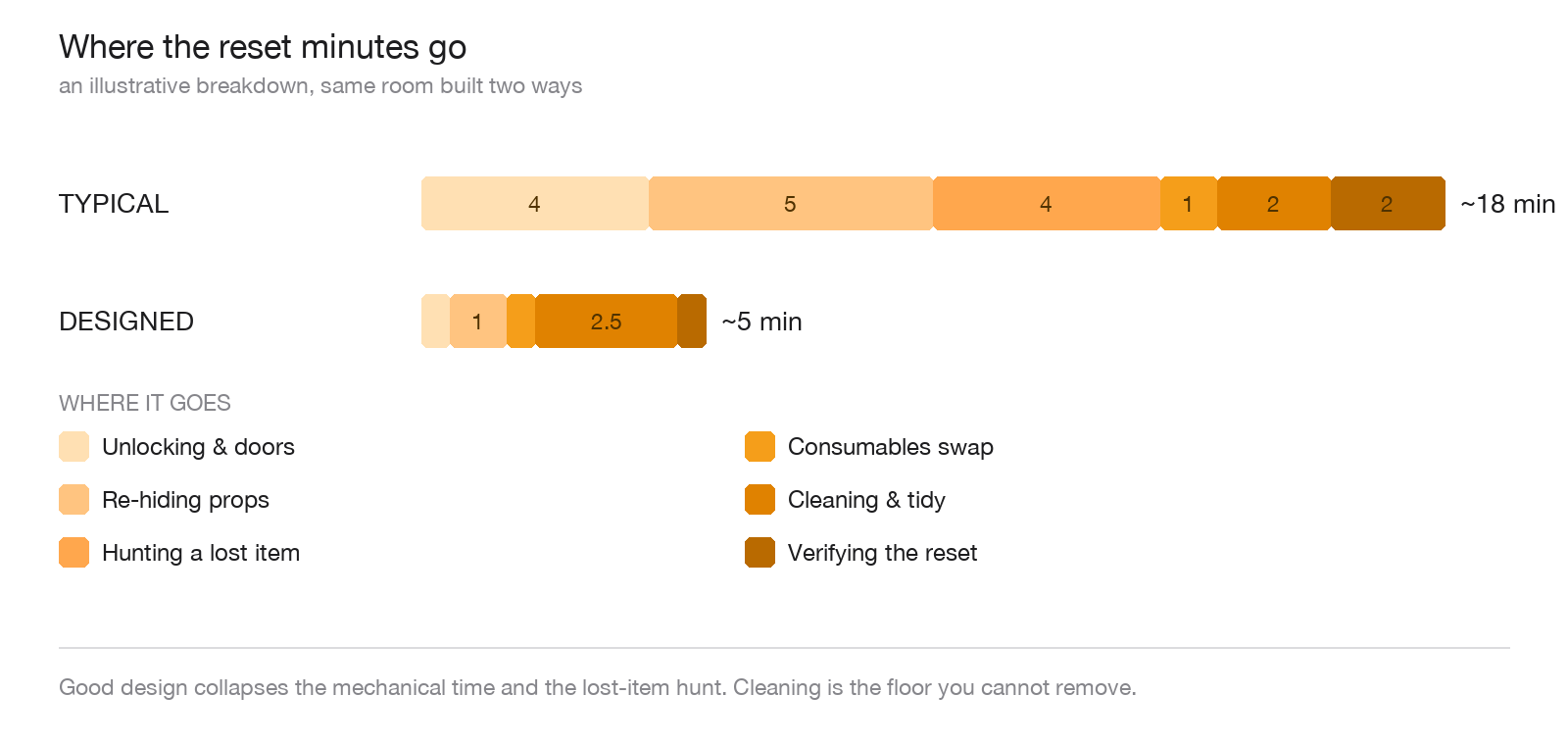
Where the reset minutes go: the same room, built two ways. Design removes the mechanical time and the lost-item hunt; cleaning is the floor.
Here is the same idea, choice by choice. The same room, built the slow way or built for reset.
- Locks. Slow way: physical padlocks with keys the game master re-hides by hand. Built for reset: maglocks re-armed by a single master switch.
- Set dressing. Slow way: loose props to reposition every turnaround. Built for reset: non-solution props fixed in place.
- Handled props. Slow way: small and easy to lose. Built for reset: oversized or tethered, the pocket rule.
- Consumables. Slow way: hand-made, one at a time. Built for reset: batch-printed, with a drawer of spares.
- Mechanisms. Slow way: custom, re-armed by hand. Built for reset: modular and self-resetting.
- Game master feedback. Slow way: check each puzzle by hand. Built for reset: a status panel confirms the room is armed.
KEY TAKEAWAY
You cannot out-hustle a room that was built to be slow. The fastest reset is the one you never have to do, because the room re-arms itself.
WATCH OUT
Speed is not the only goal. A maglock that fails mid-game, or a reset so aggressive it breaks the immersion, costs you far more than the minutes it saved. Design for fast AND reliable AND immersive, and when those three fight, let reliability win first, then immersion, then speed. A room that resets in three minutes but jams once a day is not a fast room. It is an expensive one.
One question to ask of every object
Before you sign off on any room, sketch, or refit, ask the same thing of every single object and mechanism: how does this return to its starting state, and who does it? If the honest answer involves someone hunting, kneeling, or improvising, you have just found where your Saturday goes. Fix it on paper, and you will feel it in your booking calendar for years.
Glossary
Reset (turnover) time. the minutes between one team leaving and the next being able to start. Commonly 15 to 30 minutes, and it quietly caps how many sessions a room can run in a day.
Maglock (electromagnetic lock). a lock held shut by an electromagnet and released by cutting power. It re-arms the instant power returns, which makes it ideal for fast, one-switch resets.
Reed switch. a small switch closed by a nearby magnet. Hidden inside props, it lets players trigger a lock by placing magnet-backed objects in the right spot or order.
Drop bolt (self-resetting lock). a bolt that re-latches on its own when the door closes and senses its magnet, so there is nothing to relock by hand.
Master reset. a single control that re-arms every electronic lock in the room at once.
Self-resetting mechanism. any prop designed so its default resting state is also its reset state, using gravity, springs, or magnets to return itself.
Consumable prop. anything players write on, tear, or use up. Designed for batch production and instant swap.
Modularity. building puzzles as interchangeable units, so a broken or spent element is swapped in seconds and repaired off the clock.
Spare. a pre-made duplicate of a breakable or losable part, delivered with the build so a failure is a quick swap, not downtime.
The pocket rule. design handled props too big to pocket, or tether them, so nothing walks off and turns a reset into a hunt.
Game master (GM). the staff member who runs the game and resets the room between teams.
Building a new room, or refitting one that eats your evenings?
I design escape room mechanisms with reset time as a first-class constraint, from the first Fusion 360 sketch to the finished, spare-stocked build.
Fast to reset, tough enough to survive your busiest weekend, and still a joy to play.